
Data analysis is an essential process in business, research, and decision-making that transforms raw data into meaningful insights. Whether you’re analyzing customer behavior, operational data, or research findings, the data analysis process ensures that you extract valuable insights to drive decisions.
This post covers the six-step data analysis process along with essential skills for data analysts, key terminologies, and the life cycle of data.
What is Data Science and Data Analysis?
Data Science is the study and application of methods to collect, clean, analyze, and interpret vast amounts of data. It combines elements from statistics, mathematics, computer science, and business to derive actionable insights.
Data Analysis is the systematic approach of applying statistical or logical techniques to describe, illustrate, and evaluate data. The goal is to find patterns and correlations that can help inform decision-making.
Data Scientists typically build models and algorithms, while Data Analysts interpret these models and analyze datasets, often communicating their results to stakeholders for actionable insights.
Life Cycle of Data

Data has its own life cycle, beginning from collection to eventual destruction.
- Plan: Define data needs and outline how the data will be used.
- Capture: Collect the data from relevant sources.
- Manage: Organize and store the data for future use.
- Analyze: Process the data to generate insights.
- Archive: Safely store data no longer in active use.
- Destroy: Ensure proper and secure deletion of data that is no longer required.
Understanding the data life cycle ensures responsible data management and minimizes the risk of breaches or data mismanagement.
Key Skills a Data Analysts should have
- Curiosity
Curiosity drives a data analyst to continuously dig deeper into the data, asking questions, exploring patterns, and uncovering underlying trends. It’s this innate curiosity that pushes an analyst to go beyond surface-level data. - Understanding Context
Without context, data is just numbers. A data analyst needs to understand the business or operational context behind the data, ensuring the analysis aligns with real-world objectives. This helps translate data into insights that directly impact decision-making. - Technical Mindset
Mastering technical tools like Python, SQL, or R is crucial for manipulating, cleaning, and analyzing data. However, a technical mindset also involves logical thinking, structuring data, and efficiently approaching complex problems. - Data Design
Data design refers to the process of structuring data effectively to ensure that it is accessible and easily interpretable. An analyst needs to ensure the data is designed in such a way that analysis becomes intuitive and actionable. - Data Strategy
A well-defined data strategy ensures the data being collected is useful for achieving business goals. This includes planning how data will be gathered, stored, and analyzed over time.
Key Analytical Skills a Data Analyst should have
- Visualization
Visualization is the art of translating data into a graphical format. This allows stakeholders to see trends, correlations, and anomalies at a glance, making complex data easier to digest and communicate. - Strategy
Analysts need to align their analysis with broader business strategies. This means understanding how the data fits into larger organizational goals and using it to inform decision-making at strategic levels. - Problem Orientation
A good analyst always focuses on solving specific problems. Each data analysis project should aim to answer well-defined business problems, providing solutions and actionable recommendations. - Correlation
Understanding relationships between different data points can lead to profound insights. Correlation analysis helps identify whether and how variables are related to each other, providing clues for deeper data patterns. - Big Picture vs. Detail-Oriented Thinking
Balancing between the big picture and detailed data is vital. Analysts must see the broader business goals while simultaneously focusing on the minute data points that contribute to those goals.
The Six-Step Data Analysis Process
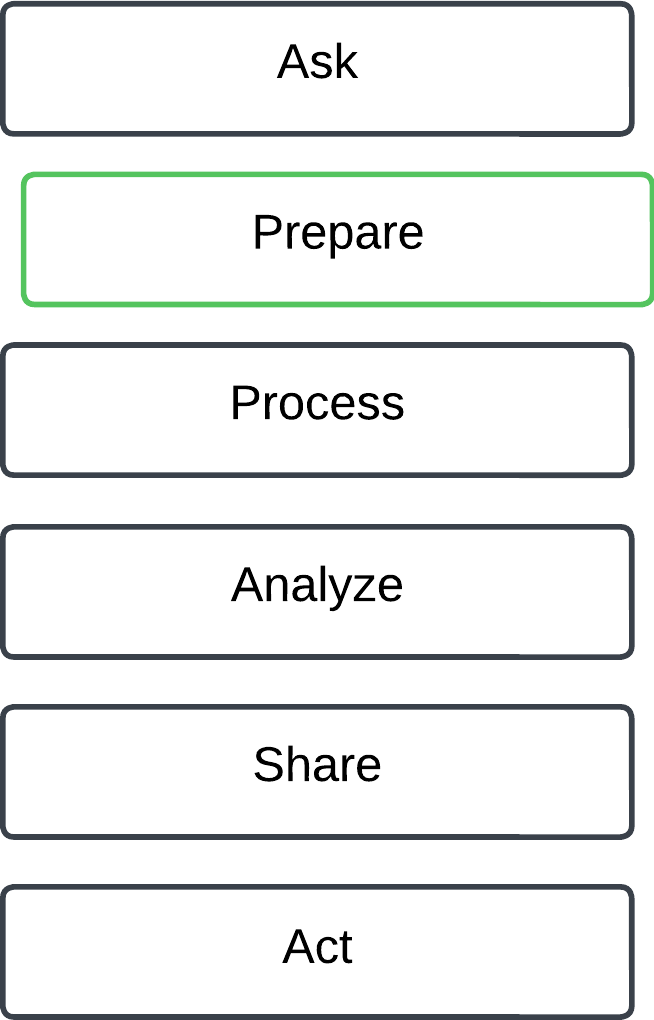
- Ask: Defining the Problem
The first step in any data analysis project is identifying the problem you’re trying to solve. What question are you hoping the data can answer?
A well-defined question is the foundation of structured thinking and helps keep your analysis focused. The SMART method can help frame questions: Specific, Measurable, Action-oriented, Relevant, and Time-bound. For example, instead of asking “Why is revenue decreasing?” you could ask, “Which customer segments have shown a revenue decline of 5% or more over the past six months?” - Prepare: Gathering Data
Once the question is defined, the next step is gathering the appropriate data. Depending on the problem, data may come from multiple sources such as surveys, transaction records, social media, or sales reports.
Preparing data includes not only gathering it but also understanding its quality and relevance. Missing or incorrect data points can skew the analysis, so steps like data cleaning and transformation are essential. - Process: Data Cleaning and Structuring
In this stage, raw data is cleaned and processed. Common issues like missing values, outliers, and duplicates are handled to ensure that the dataset is ready for analysis.
This step may involve techniques like normalization and standardization to put features on the same scale, or creating new variables (feature engineering) to enhance the analysis. - Analyze: Exploring Data and Drawing Conclusions
Here, data is analyzed using statistical methods, data mining techniques, and visualizations. You explore the data to identify patterns, trends, and relationships between variables.
This step is where you uncover insights, whether it’s correlations between marketing spend and sales, or identifying the key factors contributing to customer churn. Visualizing the data with graphs, charts, or dashboards makes it easier to interpret and share findings. - Share: Communicating Results
Data analysis is only useful when the results are shared with stakeholders in an understandable way. This could involve creating a report, building a dashboard, or presenting the findings to decision-makers.
The ability to communicate complex insights in a clear, concise, and actionable manner is essential at this stage. - Act: Taking Data-Driven Decisions
The final stage involves using the insights gathered from the analysis to inform decision-making and drive business actions. The recommendations from the analysis should lead to tangible outcomes, such as changing a marketing strategy, improving customer retention, or optimizing operations.